Qualigence International
Request a Strategy CallRun the Diagnostic
GuideSelection™ is the 6-Step Performance Engine™ applied to recruiting.

Make hiring decisionsyou can explain.

Define what success looks like, test candidates against it, and check performance after the hire. One standard, from the first conversation to the first 90 days.

The process at a glance

Carry the same definition of success through every decision.

  1. 01 / Intake

    Define success

    Agree on the result before reviewing candidates.

    Written role outcomes

  2. 02 / Interview

    Gather evidence

    Test capability against the same role outcomes.

    Examples, not impressions

  3. 03 / Feedback & decision

    Make the decision

    Compare evidence and record the trade-offs.

    Capability · risk · recommendation

  4. 04 / Integration

    Check performance

    Review progress against the original definition of success.

    30 / 60 / 90-day checks

GuideSelection - applied to recruiting

Walk it end to end.

See what each step produces. These sample documents illustrate the method, not client records or results. Open any step for the full methodology.

01

Winning

Define what success in this role looks like - measurable, visible, this quarter.

Example: Role Outcome Document
Primary ObjectiveConsistent shift handoffs with a named owner for unresolved issues.
90 DAYSAgree the handoff standard
6 MONTHSReview use across shifts
12 MONTHSAssess sustained improvement
View full methodology

What we install

A structured intake that does not proceed until three things exist: the business outcome, the success definition, and the primary capability the hire must prove. The output is a role outcome document naming the result the hire must produce at 90 days, 6 months, and 12 months. Every interview question ties back to it.

What this produces

The intake produces a one-page definition of winning: the outcome this role must impact, the capabilities that drive it, the deliverables that prove it. No search opens without it.

What this prevents

  • “Cultural fit” hiring.
  • JD-driven hiring.
  • Hiring on resume fluency instead of outcome capacity.

“Recruiting does not add value by collecting requirements. It adds value by clarifying what actually drives success.”

On your next search, this means no intake call ends without the outcome in writing.

02

Identity

Who must this person BE to win? Identity sets the behavioral standard.

Example: Behavioral Standard
Required TraitHigh Accountability Under Pressure
Observable StandardSurfaces risks proactively rather than waiting for them to be discovered.
Evaluation FocusLook for unprompted ownership of past failures without shifting blame.
View full methodology

What we install

A behavioral profile of the operator who can produce the outcome - not the resume profile. This is the difference between “10 years in banking” and “the kind of operator who’ll surface a credit problem 48 hours early instead of 48 hours late.”

What this produces

The behavioral standard in writing - who this person must be when pressure hits - so “culture fit” stops being a feeling and starts being a test.

What this prevents

  • Hiring people who match the past, not the future.

“Years of experience is not a skill.”

Steve Lowisz

On your next search, ‘culture fit’ becomes a written standard you can defend.

03

Behavior

The disciplined actions that make the result predictable.

Example: Evidence Prompt
Target CapabilityChange Management
INTERVIEW PROMPT"Walk me through a time a key team resisted your initiative. Where did you start?"
Required Evidence
Diagnosed root cause of resistance
Adjusted communication approach
Measured final adoption
View full methodology

What we install

Evidence-based interviews built through Results-Based Interviewing™ - every question exists to make the candidate prove a capability, not describe a skill. Skills are labels. Capabilities create evidence. Plus reference patterns focused on observed actions, and assessment instruments calibrated to the role.

What this produces

Every capability gets an evidence target and a prompt: “Walk me through the last time you had to do this - where did you start, what did you find, what did you change, and how did you know it worked?” Behind every prompt, two questions: why does this capability matter, and what business result is at risk without it?

What this prevents

  • Smooth interviewers who fall apart on the job. Interview the skill and you get vague answers. Interview the capability and you get evidence.

On your next search, every interview hour produces evidence you can compare.

04

Tolerance

Naming what we will NOT accept. What you allow, you approve.

Example: Red-Flag Protocol
RISKS TO INVESTIGATE
Blames previous teams for missed targets
Cannot detail the metrics they owned
Drift Exception RuleBefore adding another interview, identify the missing evidence. Record any exception and the decision owner's sign-off.
View full methodology

What we install

A red-flag protocol - specific behaviors, gaps, or signals that disqualify regardless of how strong the rest of the candidate looks - and a drift protocol for the moment discipline usually dies: “Show me more candidates.” “I’m not sure yet.” “The VP should probably meet them too.” Those aren’t requests for more talent. They’re signals that clarity broke somewhere upstream. We name them and re-anchor the decision instead of restarting the search.

What this produces

Written red-flag protocols with named owners. The exception that used to slide now needs a signature.

“Lowering the standard isn’t kindness. It is tolerance disguised as grace.”

“One more interview should never mean one more opinion. It should mean one missing piece of evidence.”

Steve Lowisz

On your next search, the exception has to be signed for - not slid past.

05

Standards

Reset deviations immediately. No private decisions.

Example: Decision Scorecard
CAPABILITY
Strategic Execution
EVIDENCE HEARD
Request a specific example of a handoff improvement.
BUSINESS RISK
Unresolved issues could pass between shifts.
RECOMMENDATION
EVIDENCE PENDING
View full methodology

What we install

A weekly inspection rhythm during the search - every active req reviewed against the standard, every drift named, every decision documented. Every piece of interview feedback must answer five things: the capability evaluated, the evidence heard, the risk, the business impact, and a recommendation. “I liked them” is not feedback. This is Monday Morning Implementation™ applied to hiring - the GDD rhythm where every standard gets inspected weekly, starting Monday morning.

What this produces

The debrief turns reaction into evidence. “I liked them” gets a follow-up: what did they say that demonstrated the capability? Interview creep - “one more interview,” “the VP should probably meet them” - gets stopped by protocol. The decision confirms the definition of winning, or names exactly why not.

What this prevents

  • Decisions made in private DMs.
  • “Just this once” exceptions that become the new normal.

On your next search, the debrief ends with a decision, not a feeling.

06

Performance

Predictable performance once the first five hold.

Example: 30/60/90 Timeline
Day 30Alignment Check

Validating the definition of winning is understood.

Day 60Evidence Check

Review observable capability in the role.

Day 90Delivery Check

Compare business impact with the agreed target.

View full methodology

What we install

A 90-day post-hire integration check. We don’t disappear at the offer. We re-engage at days 30, 60, and 90 to surface drift early - before it becomes a culture problem, before it becomes a firing decision, before it becomes a turnover statistic.

What this produces

Measured at 30, 60, and 90 days against the definition set at intake. If the first five steps held, this one is arithmetic.

“Performance becomes predictable when the first five hold.”

On your next search, 90 days later you’ll know whether the system held - because it was defined on day one.

How leadership and selection use the same six steps

Run 01 - Define with the client

6-Step Performance Engine

Applied to the client at intake to produce the definitions.

01

Winning

With the client: define what winning in the role looks like at 90, 180, and 360 days - in writing.

02

Identity

With the client: define who the hire must be when pressure hits - a written behavioral standard.

03

Behavior

With the client: turn required capabilities into evidence targets, not skill labels.

04

Tolerance

With the client: name the red flags - exactly what will not be tolerated, regardless of resume.

05

Standards

With the client: set the weekly inspection rhythm that governs the search.

06

Performance

With the client: define the post-hire measurement plan before the search opens.

Run 02 - Select with the candidate

GuideSelection

Applied to the candidate to test against exact definitions.

01

Winning

With the candidate: score their evidence against that written outcome document.

02

Identity

With the candidate: probe their history under those exact pressures.

03

Behavior

With the candidate: make them prove each capability via Results-Based Interviewing.

04

Tolerance

With the candidate: screen them against that red-flag protocol. Exceptions need a signature.

05

Standards

With the candidate: debrief their evidence against the written standard - not gut feel.

06

Performance

With the candidate: measure their actual integration at 30, 60, and 90 days against the day-one definition.

Illustrative hiring example

Turn “strong leader” into evidence a panel can inspect.

This is a sample framework for an operations manager hire. It is not a client case study and does not report actual hiring results.

Sample role brief

Operations manager

Example only · not a result

  1. Step 1 · vague requirement

    “Strong leader”

  2. Step 2 · sample desired outcomes

    Define these before the interview. They are targets, not reported results.

    • Consistent shift handoffs

      Each incoming supervisor receives the same critical operating context.

    • Accountable supervisors

      Owners, commitments, and follow-up are visible across shifts.

  3. Step 3 · interview question

    “Tell us about a real shift-handoff problem you inherited. What did you personally change, how did supervisors respond, and what showed you the change held?”

    Probe for: setting · actions · resistance · observed result · verifier

  4. Step 4 · evidence to request

    Check evidence from observed results. Do not treat the candidate's claim as proof.

    Work sample
    An anonymized handoff template, log, or routine the candidate personally introduced.
    Decision trail
    How the candidate assigned ownership, followed missed commitments, and escalated when needed.
    Reference check
    A former supervisor or peer can confirm the candidate's actions and the observed change.

The approach in practice

We run this playbook inside Fortune 500 talent teams.

At a Fortune 500 global manufacturer, we didn't run a training program. We installed a selection operating system inside the recruiting team itself: structured intakes that don't proceed without a defined outcome, interviews built to test capability instead of collect opinions, feedback standards that separate evidence from preference, and decision plans built on live requisitions - reviewed until another recruiter could run them without guessing.

The test we hold every installation to: could the system run without us? If not, it isn't installed yet.

“The goal is installation, not education.”

Read the case study

Working together

Built into your team's work. Not left in a workshop.

  1. 01

    Talk through the role

    Bring your hiring goal or a pattern that keeps repeating.

    A clear starting point

  2. 02

    Define success together

    Agree on the outcomes, evidence, and engagement scope before the search.

    A written standard

  3. 03

    Apply it with your team

    Use that standard in interviews, decisions, and post-hire integration.

    A repeatable hiring process

The six-month test: is your team still using the standard after the engagement ends? That is what we mean by an installed process.

Request a Strategy Call →

Where does your current process need attention?

Free diagnostic. 34 questions. About 15 minutes.

Run the Diagnostic →
Explore the wider framework and comparisonsHow hiring connects to leadership, how the models differ, and the four areas of implementation.

Two engines, one system

You've bought access to candidates before. It didn't fix the decision.

We've sat in the debrief where everyone liked the candidate and nobody could say why. That room is where this system was born.

Most recruiting agencies sell access to candidates. They post, search, screen, and present. The work ends at the offer.

We sell hiring discipline - the system underneath the work. We design the role for the operating environment it serves, build the screen that predicts behavior under pressure, and stay involved through the first 90 days, when most hiring decisions reveal themselves to be right or wrong.

“Frameworks help you think. Operating systems govern behavior.”

How the approaches compare

Most agencies say they're “consultative.” Almost none install anything.

  • Comparison point 1
    Traditional recruiting
    Posts, screens, presents
    “Consultative” recruiting
    Adds a strategy session
    Qualigence
    Installs a system
  • Comparison point 2
    Traditional recruiting
    Charges per placement
    “Consultative” recruiting
    Charges per project or month
    Qualigence
    Charges for installation, then optionally for ongoing operation
  • Comparison point 3
    Traditional recruiting
    Disappears at offer
    “Consultative” recruiting
    Disappears at 30 days
    Qualigence
    Stays through 90-day integration
  • Comparison point 4
    Traditional recruiting
    Sells you candidates
    “Consultative” recruiting
    Sells you a process
    Qualigence
    Sells you predictable hiring outcomes
  • Comparison point 5
    Traditional recruiting
    Standards drift under quota
    “Consultative” recruiting
    Standards drift under client pressure
    Qualigence
    Standards are the product

Where hiring sits in the system

One system. Four installs.

  • Guide Yourself™

    A universal starting point for every leader and recruiter.

    Who am I under pressure? This is the universal front door - every leader starts here, and so does every recruiter. A recruiter who has done this work reads candidates clearly instead of projecting onto them.

  • Guide Leader™

    For recruiting and hiring leaders who hold the hiring standard.

    The install for recruiting leaders and hiring leaders - the people who must hold the hiring standard when the pipeline runs thin. Installed by the Lowisz Leadership Institute.

  • Guide Others™

    For the leaders who run the hiring system week to week.

    The install for hiring leaders and recruiting leaders who run teams. It builds the group that operates the hiring system week to week, so the standard survives beyond one person. Installed by the Lowisz Leadership Institute.

  • GuideSelection

    Candidate selection through the 6-Step Performance Engine.

    The discipline of candidate selection itself. This is Qualigence - every candidate runs through the 6-Step Performance Engine, and every hire either strengthens the system or resets your tolerance.

Frequently asked

What is Results-Based Interviewing?

An interview discipline: every question exists to surface evidence of a capability tied to the role's defined outcome. Not “tell me about yourself.” Not hypotheticals. Selection is not asking more questions - it's creating enough evidence to make a better decision.

Do you replace our recruiting team?

No. We install discipline your team runs - or we run searches inside it. Both paths leave the system behind.

What if we just need one role filled?

Then we run that search - through the same engine. See How We Engage for the model that fits.

How is this different from an assessment vendor?

Assessments are one instrument inside Step 3. We install the whole decision chain - intake through integration.

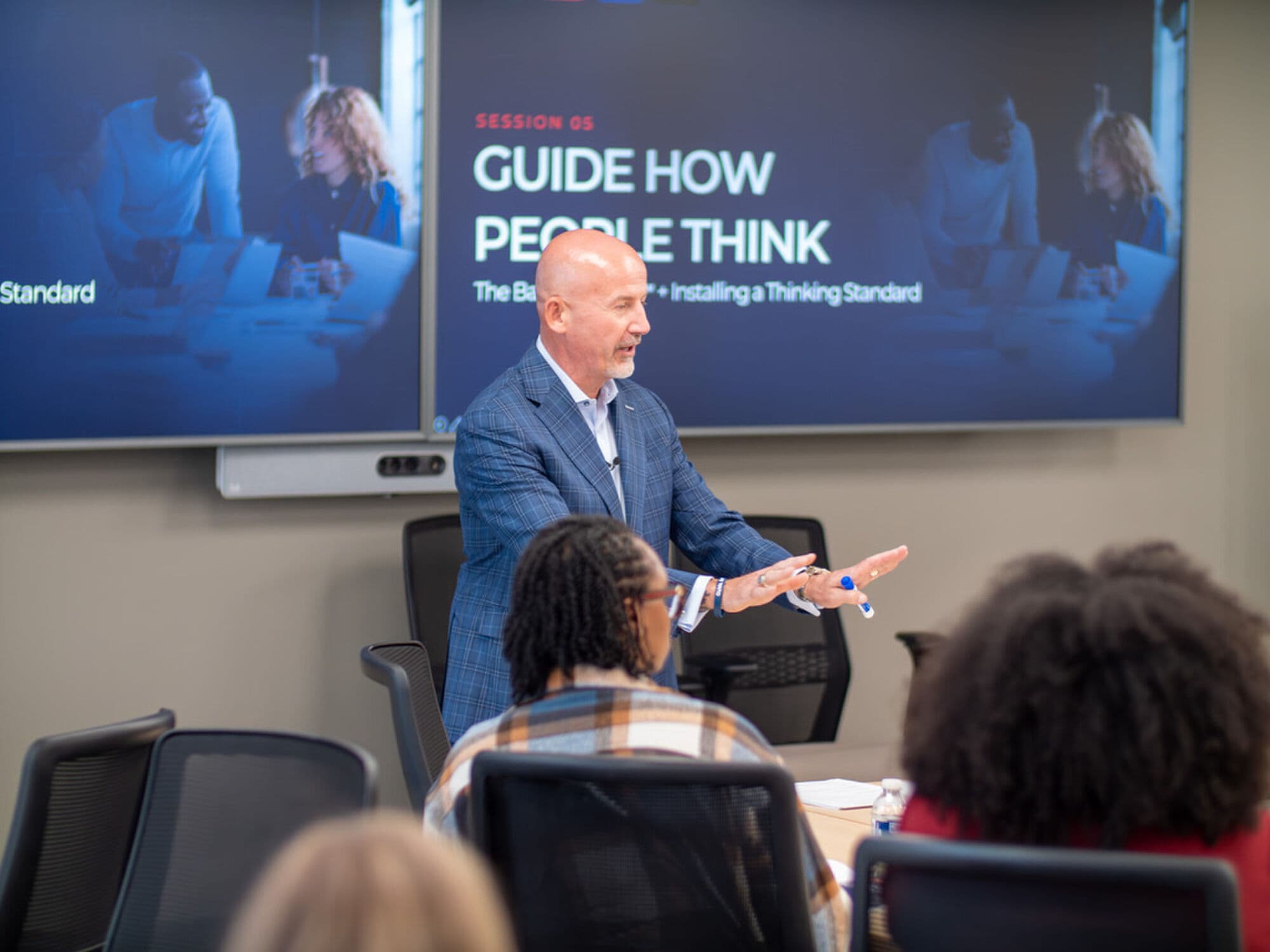
Steve Lowisz teaching a room of hiring leaders

The next step

Bring your next hiring decision. Start with a clearer standard.

34 questions. About fifteen minutes. A scored read of where your hiring breaks.

Guide, Don't Drive installs Human Performance across four domains. LLI (the Lowisz Leadership Institute) and CBI (the Community Bankers Institute) install it in your leaders. Qualigence and Qualigence Staffing install it in your selection - every hire. REI (the Recruiter Education Institute) teaches it. GuideOS, the operating rhythm, runs it every week. Steve Lowisz wrote it. One system. Different doors.

GDD logo