
The Req Opened Today. The Talent Problem Probably Didn’t.
A director resigns.
A manager gets promoted.
Growth creates a new leadership role.
Someone the business assumed was ready for the next step turns out not to be.
Then the request lands with Talent Acquisition.
We need someone.
Preferably yesterday.
At that point, the recruiting problem is obvious. There is an empty seat and somebody needs to fill it.
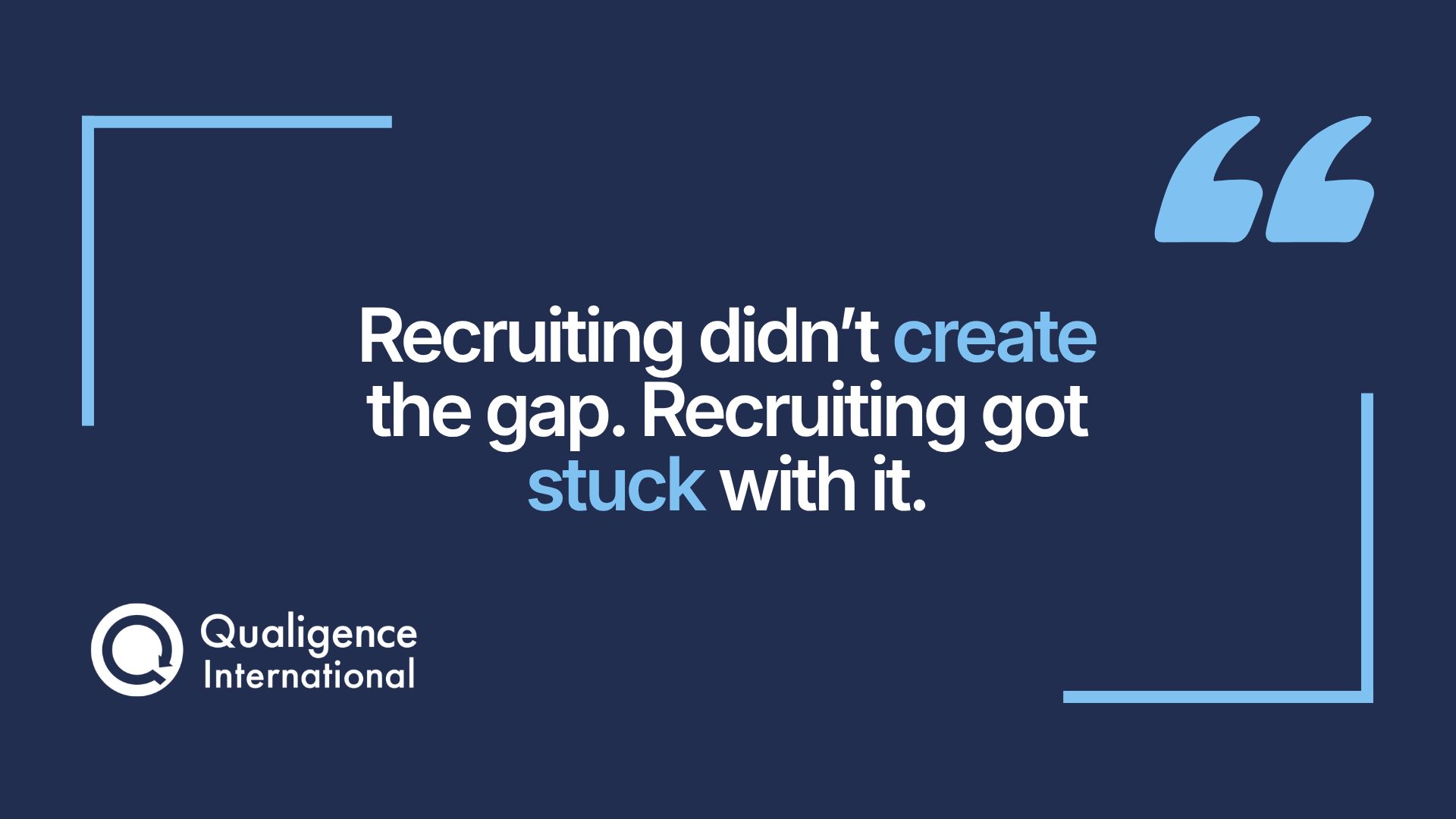
But the vacancy did not necessarily create the talent problem.
It may just be the moment the problem finally became visible.
That distinction matters because if every capability gap automatically becomes an external search, TA spends a lot of time solving problems that started long before recruiting was invited into the conversation.
Not Every External Search Is a Failure
There are plenty of good reasons to hire externally.
The business may be entering a new market.
A function may need expertise that simply does not exist internally.
Growth may be happening faster than the organization can reasonably develop enough people to keep up.
Sometimes the right person is outside the building. Go find them.
The problem is when external search becomes the default because nobody stops to ask whether the organization should have had another option.
Was there someone who could have been ready?
Was there someone ready who never had visibility into the opportunity?
Did the organization develop the capability it knew it would eventually need?
Did it know this need was coming at all?
Those are not sourcing questions.
They are talent strategy questions.
And they deserve to be asked before another recruiter starts building a search string.
Look at Your Last Five External Searches
Pull up the last five mid-level or leadership positions your organization took to market.
Now ignore who you eventually hired.
Ask why each role became an external search.
You will probably find different answers.
One was genuine growth.
One required a capability the company had never needed before.
One opened because a strong employee left.
But maybe another had an internal candidate who was “almost ready” and had apparently been almost ready for three years.
Maybe one existed because nobody had thought seriously about succession until the incumbent announced they were leaving.
Maybe another became external because employees had no clear way to move across functions, so qualified people inside the organization never entered the conversation.
Those are very different talent problems.
Treating all of them as “open reqs” hides the difference.
Your Recruiting Budget May Be Paying for a Development Problem
Companies have been under pressure to become leaner, especially toward the bottom of the talent pipeline. Current research cited in our campaign shows entry-level hiring down 6% year over year and mid-level hiring down 10%, while Gartner has warned that declining entry-level opportunities are placing more pressure on organizations to rethink how early-career talent gets hired, developed, and retained.
Cutting or narrowing those pathways can look efficient now.
The bill comes later.
First there are fewer people learning the business.
Then there are fewer people prepared for the middle.
Then succession gets thin.
Then a critical role opens and everybody asks why the market cannot produce the exact person they need quickly enough.
By then, recruiting is being asked to buy capability the organization never built.
That can cost more in compensation, time, continuity, institutional knowledge, and the ability to promote from within.
That does not mean recruiting owns employee development.
It means recruiting leaders should be close enough to the broader talent strategy to recognize the pattern.
Internal Mobility Belongs in the Recruiting Conversation
Recruiting and internal mobility are often treated like neighboring functions.
One deals with people outside the organization.
The other deals with people already there.
Nice clean boxes.
Reality is messier.
Weak internal movement eventually creates external recruiting demand.
When people cannot see or access their next opportunity internally, some leave. When capable employees are not identified or moved into larger roles, the bench stays thin. Eventually another capability gap becomes another external search.
That means a stronger recruiting strategy cannot begin and end with sourcing.
It has to understand the movement of talent across the organization.
Where are people advancing?
Where are they getting stuck?
Which capabilities are consistently being purchased externally?
Which roles repeatedly have no credible internal successor?
Where does the organization have talent but fail to see it?
Those questions tell you a lot more about future recruiting demand than this quarter’s requisition count.
Stop Bringing Recruiting in After the Talent Decision Has Already Been Made
Too many TA teams are brought into the conversation at the point where there is supposedly nothing left to decide.
Here is the role.
Here is the job description.
Here is the compensation.
Go find someone.
Then six weeks into the search, everybody discovers the business is not actually aligned on what it needs.
Or the compensation does not match the market.
Or the “must-have” experience is nearly impossible to find.
Or somebody finally asks whether there was an internal person who could do the job.
That is backwards.
Strategic recruiting should have a voice before the search becomes urgent.
Not because TA needs control over workforce planning, succession, development, and mobility.
Because TA sees something few other functions see as clearly:
where the organization repeatedly has to go outside to buy capability.
That is useful business intelligence.
Use it.
Your Open Reqs Are Leaving You Clues
If engineering leadership roles repeatedly require external searches, that tells you something.
If frontline supervisors are easy to fill but directors are not, that tells you something.
If every high-performing employee has to leave one department to advance their career, that tells you something.
If the organization keeps saying it wants to promote internally but leadership searches always go external, that definitely tells you something.
The req is not just paperwork authorizing recruiting activity.
It is a data point.
Collect enough of those data points and you start seeing where the talent system is working and where it is quietly creating future hiring demand.
A Strategic Talent Partner Should Help You Ask Better Questions
This is where the relationship between an internal TA team and an outside recruiting partner should look different.
You do not need another agency waiting for a requisition so they can start throwing resumes at it.
Your internal team can already run searches.
A useful talent partner should help your team look beyond the search.
Where are the recurring gaps?
Which capabilities should be built internally?
Where could internal movement reduce external demand?
Where does the market genuinely offer something the organization cannot build fast enough?
What hiring needs are likely coming six, twelve, or eighteen months from now?
And when external recruiting is the right answer, how do we build the search around the business outcome instead of simply replacing the last person who held the title?
That is the kind of work Qualigence wants to do with TA teams: help organizations identify where the talent gaps are and strengthen the strategy around how those gaps get filled.
Before You Open the Next Search
You are still going to have open reqs.
You are still going to hire externally.
You should.
But before the next critical role gets handed to recruiting with an urgent deadline, ask one more question:
Why did this need become an external search?
The answer might confirm that going to market is exactly the right move.
Or it might show you the next talent problem while there is still time to do something about it.
Because the best recruiting strategy does not start when the req opens.
It helps the business need fewer surprises when it does.
Before You Launch the Next Search, Look Upstream
If the same roles, capabilities, or leadership gaps keep turning into urgent external searches, filling the next req may only solve the immediate problem. Qualigence can help you look at what is creating those gaps, where internal talent could be developed or moved, and where going to market is actually the right strategy.
Let’s look beyond the open req and build a smarter talent strategy for what comes next.
.png)