
Hiring systems often look stronger when conditions are familiar.
The same hiring managers know what they want. The same recruiter knows how to read between the lines. The same leader helps clarify the decision. The same informal conversations keep the process moving.
The system may look stable.
Then something changes.
Hiring volume increases. A key recruiter leaves. A new leader enters the business. The company opens a new market. A new ATS rolls out. A team starts hiring for roles it has not had to define before. Growth accelerates. Pressure rises.
That is when the real hiring system shows up.
Not the process on paper.
The real system is revealed by what people do when the normal rhythm breaks.
Do hiring managers define winning, or rush straight to candidate flow?
Do standards hold, or start moving when the role stays open?
Do recruiters guide the decision, or become order-takers because speed feels safer?
Do leaders keep decisions at the right level, or pull every difficult call back to the top?
That is what change reveals.
Not only whether the recruiting process was documented.
Whether the behaviors needed to make stronger hiring decisions were actually installed.
The Hiring Process May Be Clear Until Pressure Hits
Many companies believe their hiring process is clear because it works under normal conditions.
The intake meeting happens. The job description gets approved. Candidates move. Interviews get scheduled. Feedback comes in. Offers go out.
But normal conditions can hide weak points.
When the business is growing slowly, a few experienced people can make the process look cleaner than it really is. A strong recruiter may compensate for vague intake. A patient hiring manager may clarify the role as the search moves. A senior leader may step in when the decision gets messy.
The system keeps moving because certain people are holding it together.
Then change exposes the truth.
The hiring volume jumps and suddenly the intake process cannot create enough clarity.
A key recruiter leaves and suddenly nobody knows how the search was actually being guided.
A new leader comes in and starts redefining what good looks like.
A new system launches and the informal workarounds disappear.
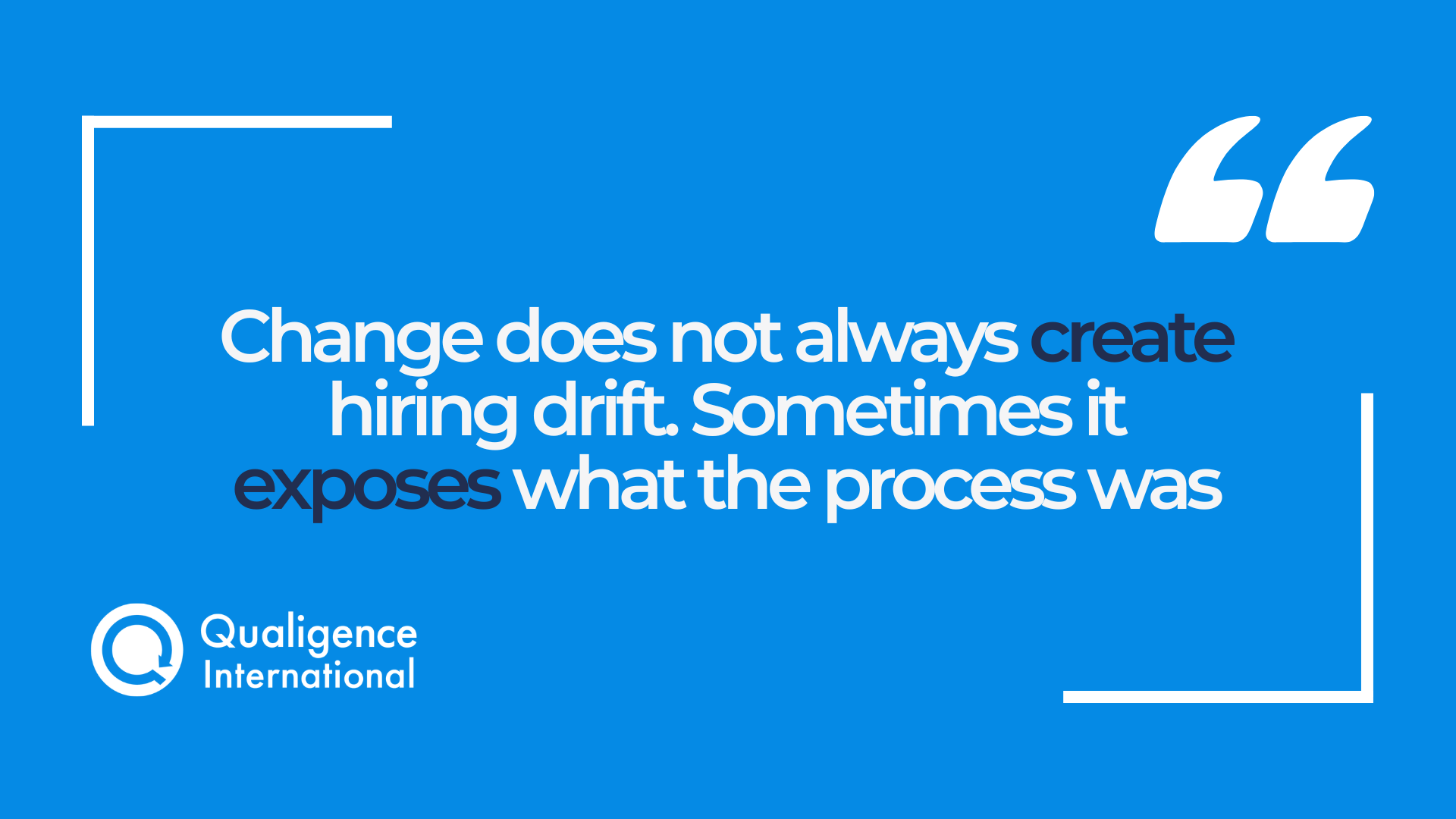
The change did not create the weakness.
It exposed what the hiring process was already depending on.
Change Reveals Hiring Dependency
One of the biggest risks inside a hiring system is hidden dependency.
The company may not realize how much of the process depends on one recruiter’s judgment, one hiring manager’s memory, or one executive’s ability to make the final call.
That dependency may not show up when the right people are in the room.
But it shows up when something changes.
The recruiter who knew the business leaves. The hiring manager who could explain the role gets promoted. The executive who always made the final call is no longer available. The company grows into roles it has not hired before.
Now the process starts to drift.
The role gets vague. Feedback gets inconsistent. The standard moves. Candidates get compared against different versions of winning. The business asks for speed because the team needs relief.
That is not just a recruiting capacity issue.
It is a decision-quality issue.
The process was depending on too much judgment living in too few places.
Old Hiring Behavior Comes Back Fast
When hiring pressure rises, old behavior comes back quickly.
Teams skip intake because the role is urgent.
Hiring managers soften the bar because the team is stretched.
Leaders ask for more candidates before clarifying the decision.
Recruiters start moving faster instead of guiding the tradeoffs.
Feedback becomes vague because everyone is busy.
The process may stay active, but the signal gets weaker.
That is how recruiting drift happens.
Not always because the team does not care. Not always because the recruiter is not working hard. Not always because the market is impossible.
Sometimes the process drifts because pressure pushes everyone back into old behavior.
Activity replaces clarity.
Urgency replaces discipline.
Relief starts to look like strategy.
The Business Cost of a Hiring System That Cannot Hold
A hiring system that cannot hold under change creates real business cost.
Roles stay open longer because the target keeps moving.
Hiring managers lose confidence because candidates feel inconsistent.
Recruiters spend time chasing shifting expectations.
Teams accept weaker fits because the business needs relief.
New hires enter roles that were never clearly defined.
Leaders feel forced to step back into decisions the process should have been able to carry.
The result is not just a slower search.
It is a weaker decision.
That matters because hiring systems do not only fill seats. They create the conditions for future performance.
If the process cannot define winning, protect the standard, and hold decision discipline when pressure rises, the company may solve an immediate vacancy while creating a longer-term performance problem.
The Deeper Question
When hiring change gets difficult, companies often ask, “Is the process working?”
That question matters.
But the better question is, “What did our hiring behavior do the second pressure showed up?”
Did intake create clarity, or did the team skip it?
Did standards hold, or did the bar start moving?
Did leaders keep the decision connected to the business outcome, or did urgency take over?
Did the recruiter guide the decision, or just drive the search?
Did the team protect signal, or create more motion?
Change reveals the hiring system you actually have because it tests the behaviors underneath the process.
The new system did not always create the confusion.
The increased hiring volume did not always create the drift.
The leadership transition did not always create the weak decision.
Sometimes change simply exposes what the hiring process was already depending on.
And if the business wants stronger hiring outcomes, it cannot only ask whether the process is documented.
It has to ask whether the right hiring behaviors hold when the search gets difficult.