
A candidate can meet every requirement in your job description and still be the wrong hire.
Why?
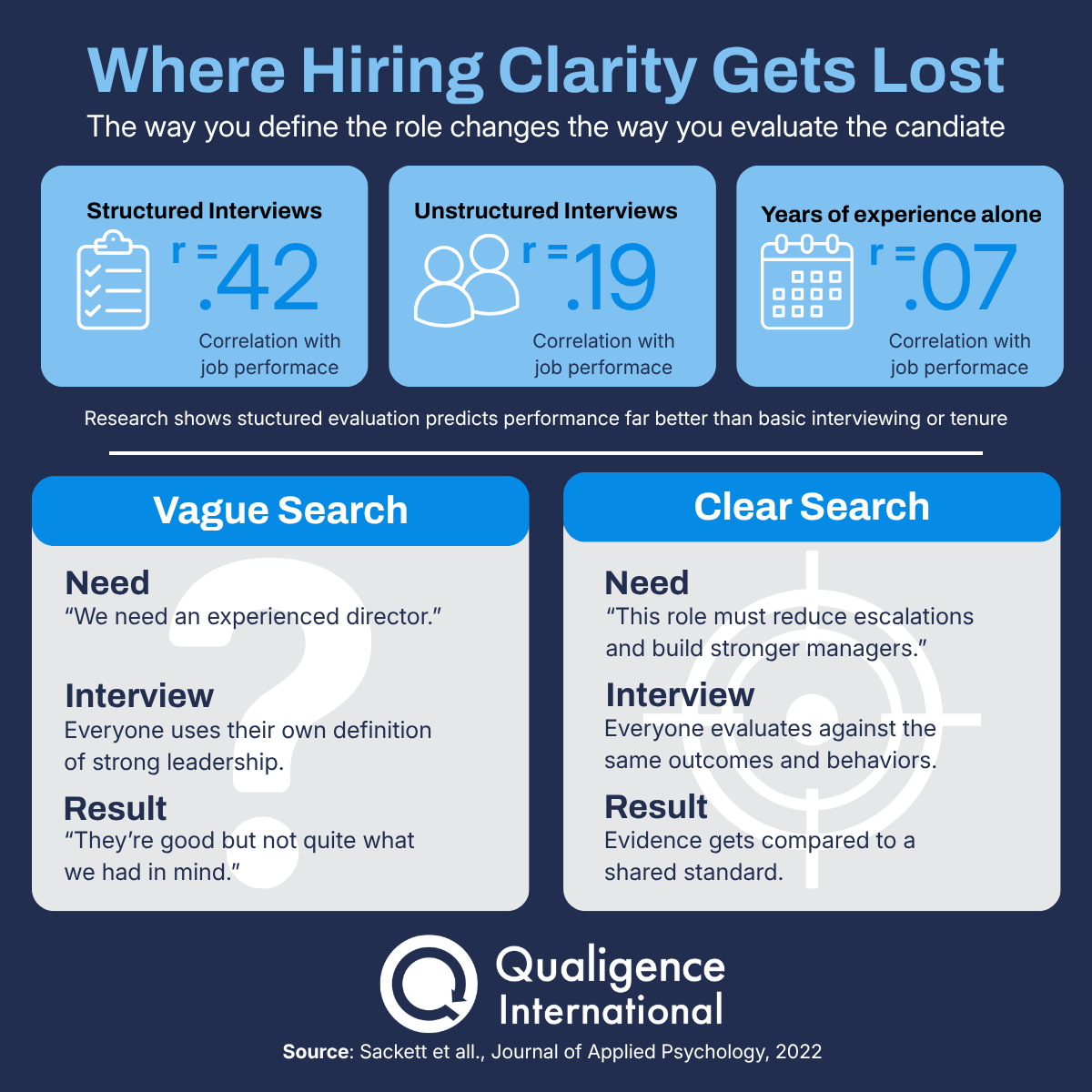
Because a job description tells recruiters what someone will do. It doesn't always tell them what that person needs to accomplish.
And when that isn't clear before the search begins, the target starts moving.
One interviewer wants stronger leadership experience. Another prioritizes technical depth. The hiring manager starts talking about "fit." Industry experience suddenly becomes more important than anyone originally said.
Eventually, recruiting hears:
"They're good, but they're not quite what we had in mind."
At that point, it can look like a candidate problem.
It may actually be a clarity problem.
A Job Description Isn't a Definition of Success
Consider the difference between these two expectations:
Manage a team of eight.
and
Develop two managers who can independently lead their functions within 12 months.
The first describes a responsibility.
The second describes an outcome.
That distinction changes the search.
If we know the outcome, we aren't simply looking for someone who has managed eight people before. We're looking for evidence that a candidate has developed leaders, built capability and successfully reduced dependency on themselves.
The same thing happens across nearly every role.
"Own key customer relationships" describes an activity.
"Retain and grow our highest-value accounts while reducing escalations to senior leadership" describes what winning actually looks like.
Now we know what we're searching for.

Better Recruiting Starts Before the Search
This is where recruiting can become too focused on matching resumes to requirements.
Ten years of experience.
The right title.
Industry experience.
A specific system.
A particular credential.
Those things may matter. But none of them automatically tells you whether someone can solve the business problem that created the opening.
That's why we believe a strong search should start with a different question:
What needs to be different because this person was hired?
Then we can determine what experience, capabilities and behaviors actually predict whether someone can produce that result.
That's a very different search than simply matching candidates against a job description.
This Is Where Qualigence Approaches Recruiting Differently
At Qualigence, our job isn't simply to find people who match a list of requirements.
We want to understand why you're hiring in the first place.
What does this person need to accomplish?
What problems are they walking into?
What will they own?
What capabilities need to exist on Day 1?
What can be learned?
And six or twelve months from now, what would make you say, "This was absolutely the right hire"?
Those answers give our recruiting team a much stronger target.
Instead of searching only for familiar titles, years of experience or keywords, we can look for evidence that candidates have solved similar problems and produced the outcomes your business actually needs.
It also gives your hiring team a clearer standard for evaluating the candidates we bring forward.

Define the Win Before You Search for the Winner
Before opening your next search, ask everyone involved in the hiring decision to finish this sentence:
Six months from now, this person is winning if...
Compare the answers.
If the recruiter, hiring manager and interview team are describing completely different outcomes, that's valuable information to uncover before sourcing begins.
Because finding better candidates isn't always about searching harder.
Sometimes it's about defining what you're searching for more clearly.
Planning a critical hire? Start by defining what winning actually looks like.
If you're ready to build a search around the outcomes your business actually needs: