
When a role opens, the hiring process often starts by looking backward. The old job description gets pulled up, the hiring manager makes a few changes, and the replacement profile starts to take shape around what the last person brought to the role. Their title, industry experience, systems knowledge, years of experience, and career path all become reference points for the next hire.
There is nothing inherently wrong with that. The experience of the previous employee can tell you a lot about what the role requires. The problem is when those reference points quietly become requirements simply because they are familiar.
Before long, the search is no longer built around what the business needs next. It is built around finding another version of the person who just left.
The last employee is not the job description.
The Role May Have Changed More Than You Think
A replacement search can feel straightforward because the role already exists. The organization knows what the person did, how the work was structured, and where the position sat in the business. That can make it tempting to treat the opening as a vacancy to refill rather than a role to reconsider.
But the business may have changed significantly since the last time that position was hired.
New technology may have altered the work. Customer expectations may have shifted. The team around the role may be structured differently. Responsibilities that used to sit elsewhere may now belong to this person. The business may be growing, consolidating, entering new markets, or asking the role to operate at a higher level than it did before.
If those changes are not reflected in the hiring profile, the organization can end up recruiting for a version of the job that no longer really exists.
That is why a replacement search should not begin with, “Who looks most like the person we had?”
It should begin with, “What does this role need to accomplish now, and what will we need from it next?”
“Hit the Ground Running” Can Narrow the Search Too Far
Hiring managers naturally want someone who can contribute quickly. A candidate who already understands the industry, knows the systems, and has handled similar responsibilities should require less ramp-up time. In many situations, that is a legitimate advantage.
The problem is when “hit the ground running” becomes the organizing principle for the entire search.
That phrase can quickly turn into a long list of requirements designed to eliminate as much uncertainty as possible. The candidate should come from the same industry, have the same title, know the exact platform, carry a certain number of years of experience, and ideally have solved almost the exact same problems somewhere else.
The resulting profile may be very easy to understand, but it can also become unnecessarily restrictive.
A candidate from an adjacent industry may need time to learn the market but bring stronger judgment or leadership experience. Someone who has never used your exact software may have successfully learned several comparable systems. A person without the expected title may already be operating at the level the job requires.
If the hiring process only rewards familiarity, those candidates may never make it into the conversation.
A short learning curve has value. It just should not come at the expense of a much longer runway.
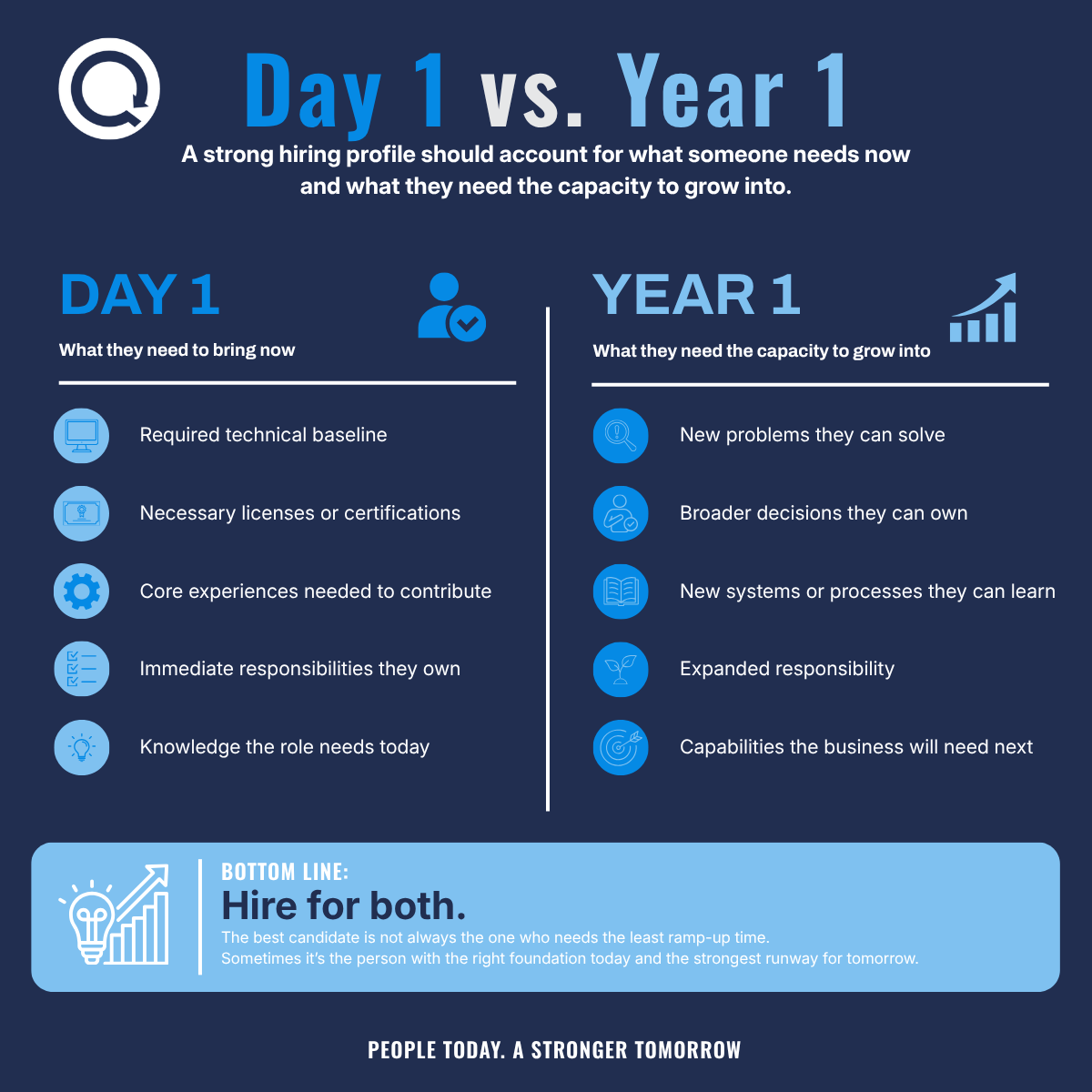
Separate Day 1 Requirements From Future Capability
One of the most useful ways to pressure-test a hiring profile is to separate immediate requirements from future capability.
The first question is practical: What does this person genuinely need to know or be able to do on Day 1?
Some requirements will absolutely belong there. A role may require a specific license, certification, technical baseline, or type of experience that cannot reasonably be learned after the person starts. Those are real constraints and should remain part of the profile.
The second question is different: What will this person need to be capable of doing 12 to 24 months from now?
That requires looking beyond the current responsibilities of the role. What problems are becoming more important? What decisions will this person eventually need to own? What skills are likely to change? What new responsibilities could land in the role as the business evolves?
Those questions often reveal that the strongest long-term hire is not necessarily the candidate who checks every box today. It may be the person who has enough of the right foundation now and stronger evidence that they can grow into what comes next.
That is the distinction between hiring for immediate proficiency and hiring for capability.
Every Requirement Should Earn Its Place
Every “must-have” added to a hiring profile changes the size and shape of the candidate market.
Requiring exact industry experience removes people with adjacent backgrounds. Requiring a specific title can eliminate candidates performing the same level of work under a different naming structure. Requiring familiarity with one particular system can screen out people who have demonstrated they can learn quickly but simply have not used that platform yet.
None of those requirements are automatically wrong. The issue is whether they are tied to an actual business need.
A strong hiring process should be able to answer a simple question:
What does this requirement protect?
Does it reduce a meaningful business risk? Does it predict performance? Is it necessary for the person to be productive in the role? Or is it there because that is what the previous employee happened to have?
If a requirement dramatically narrows the market but nobody can explain why it matters to success, it may be worth reconsidering.
That is not lowering the bar. It is making sure the bar is measuring the right things.
Familiarity Is Easier to See Than Capability
One reason hiring teams lean so heavily on titles, years of experience, and exact backgrounds is that those things are easy to identify on a resume. Capability is harder to evaluate.
It takes more work to understand whether someone has repeatedly learned unfamiliar systems, handled increasing levels of complexity, taken on broader responsibilities, or made good decisions in situations they had not encountered before.
Those indicators are less tidy than a checklist, but they can be far more useful when the role itself is likely to change.
A candidate can look almost perfect on paper because their background closely mirrors the current job and still struggle when the environment shifts. Another candidate may look less obvious because their experience is adjacent rather than identical, yet have a much stronger history of adapting, learning, and taking on more complex work.
That is why the question cannot stop at, “Have they done this before?”
It also needs to include, “What evidence do we have that they can handle what comes next?”
Let the Market Challenge the Profile
Sometimes the hiring market itself is the first indication that a search needs to be reconsidered.
The recruiting team may find that candidates with the exact requested background are scarce, uninterested, or far more expensive than expected. They may repeatedly encounter strong candidates who fall outside one inherited requirement but appear capable of doing the work. They may also discover that the qualifications being emphasized are not showing up alongside the capabilities the business actually cares about most.
When that happens, it is easy to treat the problem as a sourcing issue and simply push harder.
Sometimes that is the right response.
Other times, the market is telling you something about the profile.
A strategic recruiting partner should be able to bring that information back to the hiring team and help interpret it. If one requirement is excluding a large portion of otherwise strong candidates, the question should not simply be how to find more people who fit it. The question should be whether that requirement is worth what it is costing the search.
That is where recruiting becomes more than execution. Market feedback becomes business intelligence that can improve the hiring decision itself.
Hire for the Role You Are Becoming
The goal is not to ignore experience or pretend every candidate can learn everything after they start. Some requirements genuinely matter from the first day, and there are plenty of situations where direct experience is exactly what the business needs.
The goal is to stop treating past similarity as the same thing as future fit.
Before launching another search, take a fresh look at the profile. Identify what someone truly needs to bring on Day 1, what can reasonably be learned, and what the role is likely to demand as the business changes.
Then ask whether your requirements are helping you find that person or simply helping you recreate the one who came before them.
You are not just hiring someone to do the job as it exists today. You are hiring someone who still needs to succeed when that job changes.
LET’S RECALIBRATE THE ROLE
If the market is challenging the profile, Qualigence can help separate the requirements that actually predict success from the ones unnecessarily narrowing the search.