With economic indicators pointing towards growth in the new year, many organizations are planning for more hiring in 2026 than they saw in the last couple of years. Project that were in limbo are ramping up. Headcount plans are moving nearer. Leaders are asking talent acquisition how fast they can respond.
The headcount question asked is usually the instinctive one: “How many recruiters do we need?” That question is understandable, but it is also how companies end up overbuilding internal TA teams, only to cut them again when demand shifts. It is a painful cycle that does more harm than good by eroding morale and making it harder to hold on to your top talent.
A better question heading into 2026 is this: How do we design recruiting capacity that flexes with demand, without breaking our budget or our team?
Being a part of client’s recruiting plans for over 25 years, we have a few insights into practical approaches to building your recruiting capacity planning, including how to use internal recruiters, fractonal support, and our strategic hourly recruiting model built to help internal TA teams stay scalable and defensible.
Why overbuilding TA is so tempting, and so risky
When forecasts point to more hiring, the pressure to respond builds quickly. Business leaders want to see capacity in place before requisitions open. TA leaders do not want to be the bottleneck, so they push to add internal recruiters. In the short term, that can feel like a strong, committed response.
The risk surfaces later as hiring rarely follows a straight line. Budgets shift from week to week. Product roadmaps change on a whim. Forecasts no longer match up to the new reality. Suddenly, the TA team that felt “just right” for peak demand looks oversized for the new reality. Internal recruiters, who were brought in as partners for growth, become the prime target for cuts. And when those cuts come, morale takes a cut in kind.
The boom and bust cycle stretch TA too thin or can leave them carrying too much fixed cost. Expensive in financial terms and costly in human terms.
Capacity planning for 2026 needs a more flexible model.
Think in portfolios, not just headcount
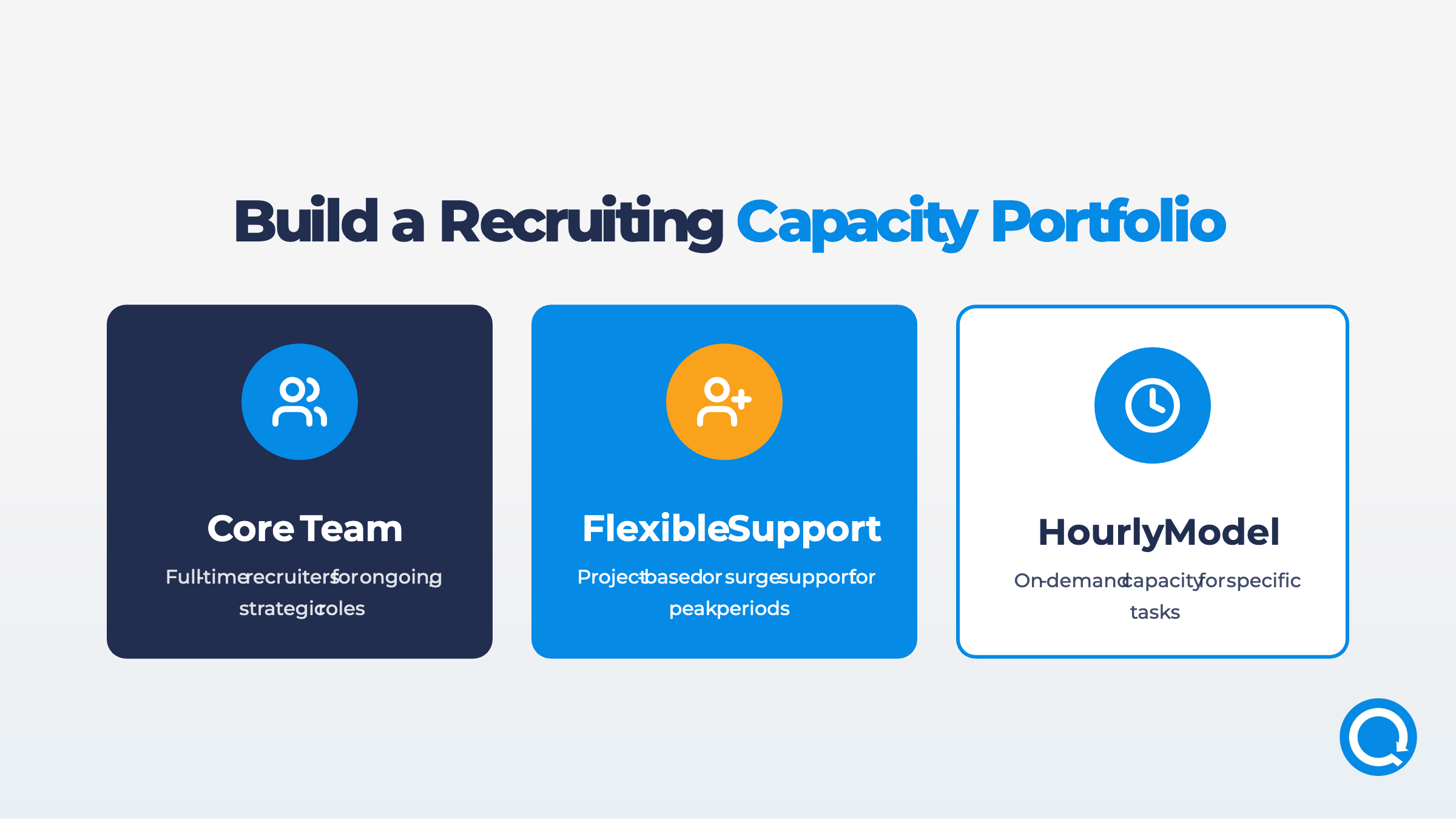
Instead of treating recruiting capacity as a single number of full-time recruiters, treat it as a portfolio built from three components.
The three components of a flexible recruiting capacity portfolio
- The Core Internal TA Team - Sized for the baseline work you can reasonably expect every year. The people you can lean on to deliver year after year.
- Fractional Recruiting – Contracting a 3rd party recruiter on a fractional basis can support spikes and special projects with hard to fill roles.
- Process and Technology Improvements – With advancements happening year over year, you can easily increase the number of quality hires your existing team can support.
The internal core provides continuity, culture, and partnership with the business. Fractional recruiting allows you to respond to changes without locking in cost. Better process and tooling make every recruiter more effective.
This portfolio approach changes the planning conversation. The question is no longer: “Can we afford these extra recruiters forever?” It's more: “What's the right mix of capacity that will support our range of scenarios?”
Smarter ways to flex recruiting capacity
There are several levers you can combine to avoid overbuilding TA while still being ready for higher volume.
Project and surge recruiting
Use project-based support when you can see defined spikes in advance. This might mean opening a new location, launching a product, or building a specific team. You bring in help with a clear start and end, and you do not carry that capacity when the project is complete. Plus the next time a project comes up, you have a team that’s already familiar with your market segment and culture, so new projects can have their timelines shortened.
Specialist support for critical or niche roles
For executive and highly specialized roles, dedicated search support can be more efficient than expecting generalist recruiters to cover everything. This keeps your internal team focused on the roles they can fill most effectively. Sometimes just having a bit of research from an external team while the internal team focuses on the heavy lifting can make all the difference in the quality of hire and candidate experience.
Hourly recruiting as a strategic pricing model
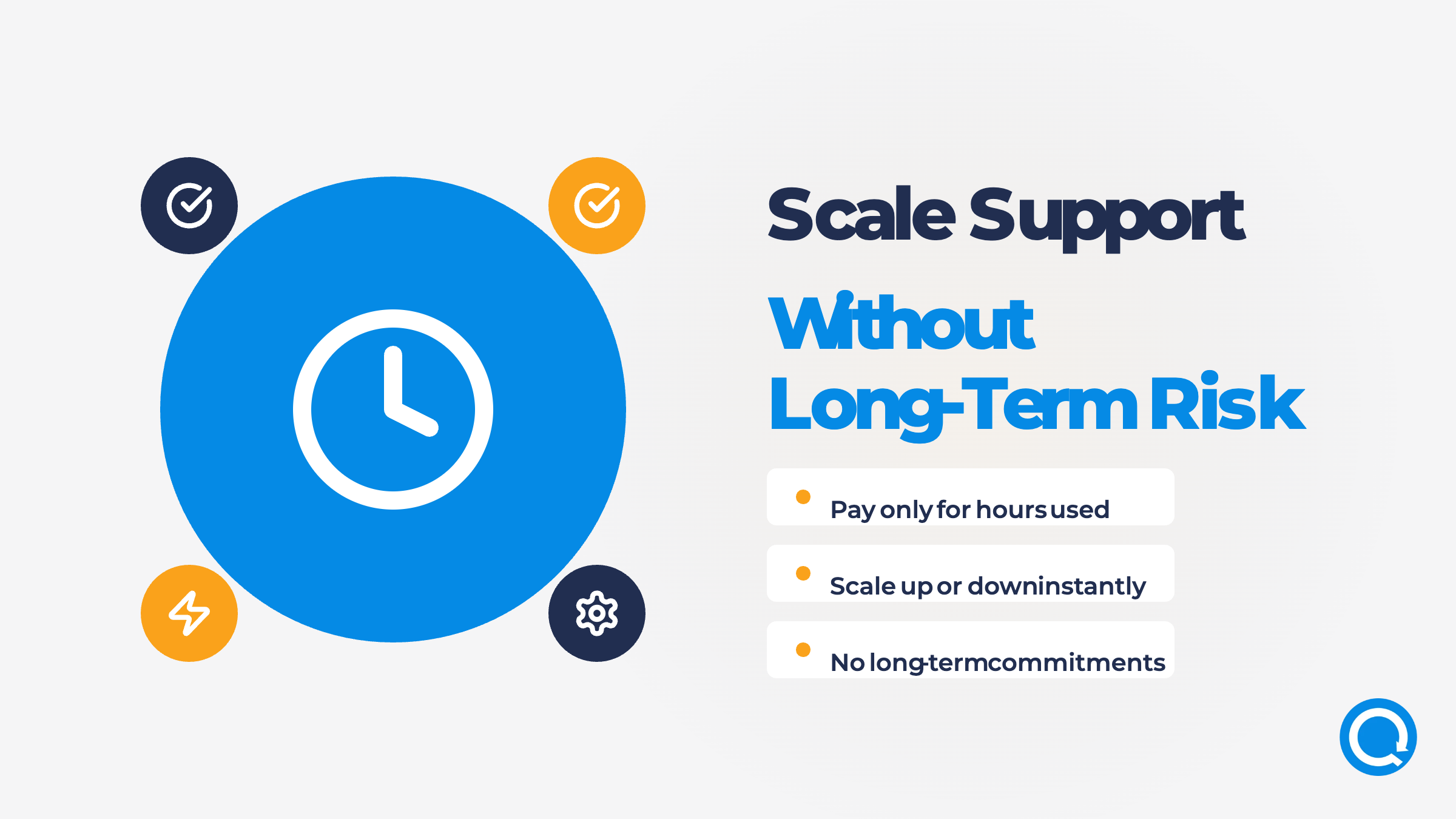
Hourly recruiting is one of the most powerful ways to add expert capacity without taking on permanent cost or percentage-based fees. Instead of paying a placement fee tied to salary, you pay for the actual work being done: research, sourcing, outreach, screening, and candidate management, all aligned to a clear plan.
Because pricing is based on hours rather than a percentage of compensation, it is easier to control cost and match investment to real need. You can ramp hours up when volume spikes, scale them back when volume normalizes, and see exactly where effort is going. That makes hourly recruiting a strong fit for organizations that want:
- experienced recruiters working a defined process
- transparent, predictable cost instead of variable placement fees
- flexibility to adjust support by month or quarter
- a focus on quality and long term fit rather than quick placements
We’ve built our Hourly Model specifically to become an extension of your internal team and help build capacity when clients need it most.
Use scenarios, not a single forecast
Like weather forecasts, they’re wrong more often than they are right. Scenario planning gives you a way to be ready for different outcomes without overreacting.
The three-scenario model
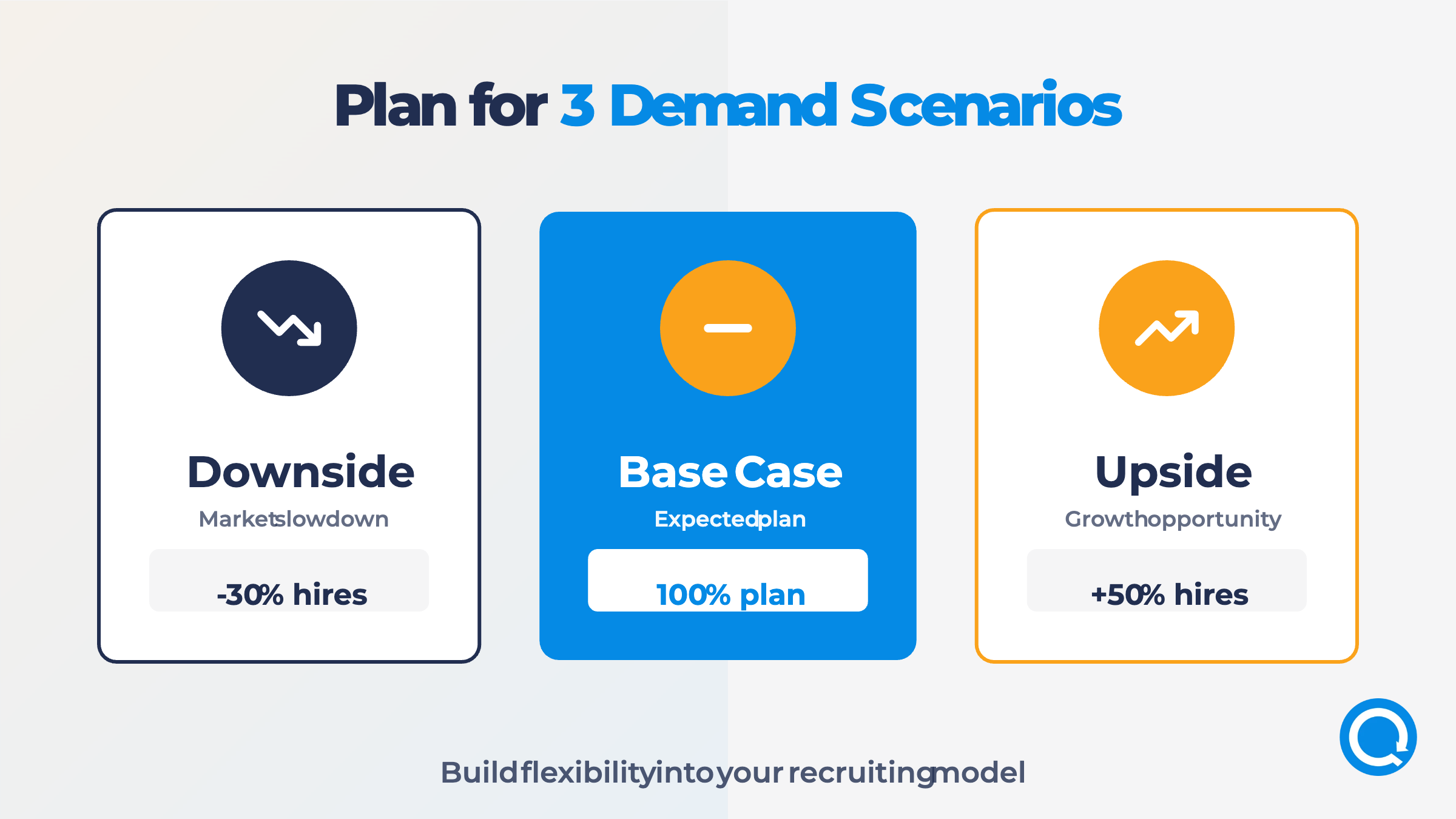
A simple model that works in most cases includes three scenarios:
- Base case: your most realistic hiring plan based on confirmed initiatives.
- Upside case: a higher volume scenario if growth accelerates or new projects land.
- Downside case: a reduced volume scenario if budgets or priorities change.
What to define in each scenario
For each scenario, outline:
- An approximate requisition volume by function and level
- What your internal TA core can support
- How much additional capacity you would need
- Which levers you would use first (hourly recruiting, projects, specialist support)
- The specific signals that would trigger a move from one scenario to another
Now your plan is simply based less around circumstances you can’t control, and becomes more about following a clear path set out from the beginning.
Process improvements as hidden capacity
Sometimes the fastest way to gain capacity is not adding people at all. It is removing friction and waste from the current process.
Where to look for friction
Examine common areas for improvement:
- Intake quality: Are roles well defined, or are recruiters burning time on rework and misalignment?
- Interview process: Are you taking the relevant steps, or has the process grown without being trimmed?
- Decision speed: Are candidates waiting for long internal debates that could be streamlined?
- Automation: Are recruiters handling work that AI or simple tools could support, such as scheduling and basic communication?
Cleaning up these areas frees up meaningful time for recruiters to focus on high value work. Reducing the need for extra capacity often without any spend attached.
Bringing TA into workforce planning earlier
Recruiting capacity planning is strongest when TA is in the room early, not after headcount decisions are final.
What changes when TA is involved early
When TA is part of workforce planning, you can:
- Identify which roles will be hardest to hire in a rebound
- Highlight where internal mobility or development can reduce external hiring
- Set realistic expectations about timelines and candidate availability
- Translate headcount plans into capacity requirements and options
That early involvement makes it easier to justify a portfolio approach, including the use of hourly and fractional recruting models. It also positions TA as a strategic partner, not just an execution team.
Training TA to be strategic partners
If you’re looking to train your TA team to be more of that strategic partner, our Recruitment Education Institute has many courses to position your team for success.
The recruiting takeaway
Preparing for increased hiring volume in 2026 is less about guessing the perfect recruiter headcount and more about designing a flexible capacity model.
A strong plan rests on three pillars:
- A right sized internal TA core that can support stable demand
- Various levers, including hourly/fractional recruiting, that you can scale up or down
- Smarter processes and tools that increase the impact of every recruiter
When you build capacity this way, you support growth without overbuilding TA, you reduce the risk of painful cuts later, and you give your business a clear story about how talent acquisition will keep up with whatever 2026 brings.
Want a portfolio-based capacity plan for your 2026 hiring scenarios?
If you want to see what a portfolio based capacity plan could look like for your organization, including how an hourly recruiting model can plug into your base, upside, and downside scenarios, we can walk through a simple planning exercise with your team.